"Life is a Circle" Part Two
In Gambia, everything centres on salutation: the greeting of a friend or a stranger, accompanied by questions about family and friends, which can only be placated with thorough, detailed reassurance.

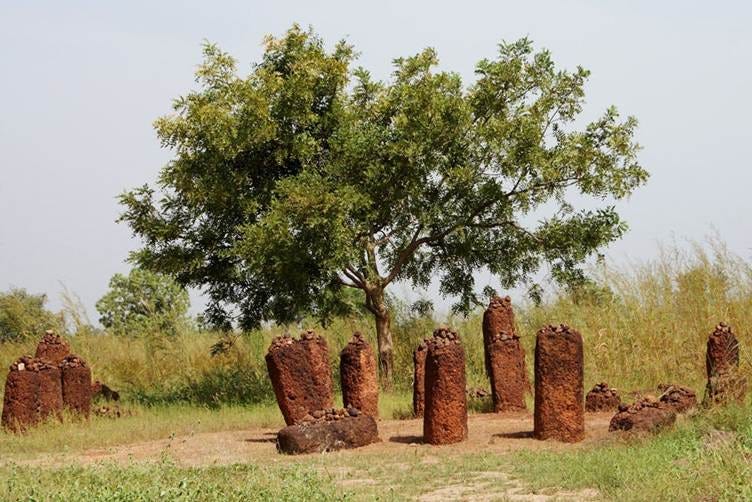
Wassu stone circles, Georgetown, Gambia.
See Part One of Life is a Circle here.
I later wrote a card to my relative, Uncle Charlie, in Jamaica, while in Gambia in 1994. I had the opportunity to visit and be guided around the country, way beyond the small tourist belt.
Our guide was from the Jola, a minority Muslim tribe in the mostly Christian Gambia. The Jola are syncretic Muslims, retaining ancestor veneration and male initiation rites of passage. As we got to know each other, he later explained that he had resumed attending his local mosque when he could and was praying regularly. He did not care much for the Saudi version of Islam that was spreading in West Africa at the time, preferring what had been passed down through his elders.
Everywhere he took me, and everyone we met exhibited kindness, politeness and exceptional hospitality. The tour fee was nominal. All that had been asked of us was that we bring pencils, pens, and paper for the children’s schoolwork. I also brought as many books as I could for their school library.
In Gambia, I was struck by the excellent behaviour of the children and young people, and I discussed with my guide the challenges in his community compared to England, and we compared notes.
He told me the biggest problem was the lack of business and job opportunities for an increasingly well-educated populace. Women dominated market trading, but the country needed everything from engineers, infrastructure, well-diggers, to microbusinesses, sewing machines for tailors, and dressmakers.
My guide could not understand the neglect of the elderly and the sexual abuse of children when I explained that, despite a wealthy economy and many opportunities, we had many broken families in the UK.
In Gambia, everyone seemed to live in extended, multigenerational households, and the whole extended family took pride in and watched over the children. There had been a case of child abuse in the national paper, and it had shocked the nation and led to much soul-searching.
He explained that sex before marriage was impossible during his grandparents’ generation; later, it became tolerated, though only discreetly, if a couple were going to marry. The legal age of consent is 18. But there are cases of marriages as young as 15, though not particularly in the Jola.
Then, in hushed tones, he explained a recent scandal in which one man in the area had got a girl pregnant and refused to marry her, and left for another town. Some people from the village, not just family members, tracked him down and demanded that he marry the girl, but he still refused.
A standoff ensued, and the police were called. It ended up in the local newspaper, but he only agreed to pay an agreed amount toward the eventual child’s upkeep. It was shocking and brought great disgrace to the man’s family.
Later, on our flight home, a UK free newspaper was handed out. The headline story featured a woman raped in a train carriage, while other passengers looked on. Police were called, but there had been no one to prevent her ordeal.
We all concluded that while England had a first-class economy and all that goes with it, its people were, and we partially included ourselves in this, third-class, by contrast with Gambia, where things were the opposite.
I had read of Africanity but met it in Gambia. One vivid memory was the serving of food. Wherever we travelled, out of tourist hotels and into the villages, food tended to be served collectively in a huge plastic or enamel bowl or dish, laid on the floor. The meal was invariably rice, cassava and sometimes meat.
You washed your hands, then squatted or sat and ate with one hand, no knives or forks. Gradually, you became accustomed to kneading the ball of rice in the palm of your hand, letting it cool, then eating it, careful not to take more than your fair share.
It was very uncomfortable, the height of communalism and a real, almost psychological clash with our preference for plates, knives and forks. It was also the way the food was offered, with delight. I was convinced that the whole process made the good food taste exceptional. This is not typical for all parts of Africa, of course.
After we returned home, my guide’s brother, whom we had met briefly when he was not working at the main hospital, expressed interest in coming to England and eventually came and stayed with us for a fortnight.
It wasn’t easy to lavish the kindness and hospitality on him that we had received in his country, where everyone stopped what they were doing to make outsiders and guests feel welcome. But we tried our best and held a party for our friends to welcome him. We tried our best to get time off work and show him the local sights, just the same.
A couple of years ago, the same brother explained he would be in the U.K. again for business in the Midlands, and asked to meet with me. He had put on a little weight, which was actually good, as he was always very slim, but was still the effortlessly decent, moral, well-mannered man I recalled.
In the intervening years, his conduct seemed something from another age, perhaps my childhood, and his now-grown daughter and a Gambian business friend were also present. He had matured into an astute businessman. and developed a business importing UK medical equipment to the Gambia.
I recounted stories of what I had seen in Gambia, and he was delighted that I remembered so much about my visit to his country thirty years earlier. In particular, I talked about a journey we had taken with his brother up country to George Town to see the standing stone circles at Wassu.
George Town is the oldest town in The Gambia outside the capital, Banjul, and was founded in 1823 by Captain Alexander Grant, who was sent from the British colonial office to suppress the slave trade and establish trading relations and a settlement for formerly enslaved people.
At the time, I was trying to make sense of the stone circles in England and Ireland. I was intrigued by the possibility of migrations from north-east Africa to western Spain, Ireland, and Wales in previous millennia and the Stone circles in the Gambia, which date much later to 750-1000AD.
George Town is poor, as is much of the country, but the people were decidedly rich in humanity. Most of the people were immaculately turned out. A teacher friend of my guide gave up his home, a mud-brick single-floor terrace house with a corrugated roof, for us to sleep in. Corrugated roofs had the advantage of not needing to be rethatched every year. But the disadvantage was the stifling heat, particularly at night.
All the children at the local school had starched and ironed uniforms, and were eager to learn in often dilapidated school buildings. That evening, my guide and the teacher who knew a little about the stone circle took me to see the Head teacher to ask for permission to be exempted from work on the following day, so he could take me to see the site before we had to return to the capital. Another very modest fee was agreed.
There was no electricity in the town after a dispute with the authorities over a bill, so the evening brought the hum of petrol generators. We found the red-brick school, built during colonial days, and the elderly head teacher alone on a moonless but starry night in the school yard, listening to the news on his small radio, as the location offered better reception than his home.
It was 27 April 1994, and he was listening to the news that the ANC had won their first free election in South Africa, 6000 miles away. He was hopeful for the continent, delighted that a guest from England would come to his town and community and gave his permission for his teacher to take us to the site the next day.
When I spoke to the head teacher via translation and said I was British, he was curious about my parents and family. He spoke of the colonial times when he was younger - colonialism had its strengths as well as its weaknesses; he told me the transport infrastructure brought by the British was now sadly in decline. (I later visited the newish national sports stadium, built by the Chinese in 1984, and since then, the costs of its maintenance had become a national embarrassment.)
Back to the present, we eventually turned to the U.K. today. They were impeccably polite and positive about the wealth and opportunities in the UK. Still, again we did a comparison between our two countries as I had done with his brother thirty years before.
It seemed there had been some economic progress in Gambia, but it was still a poor country with corruption amongst the political elite. A return to democracy had brought some stability, but its families remained as strong as ever.
I explained the UK economy was okay, but there was a sense of general decline - the subject of Trans and LGBTQ came up as it was prominent in the news at the time. They noted that such a prosperous country and England, such industry, and opportunity, that, whilst they were keen not to offend me, they thought some form of madness had taken hold.
Apparently, a friend of his daughter had gone abroad to study and then work and subsequently declared themselves a lesbian, which caused incredulous bafflement for family and friends. Their Gambian views were similar to those I had heard in my childhood.
The Pakistani gang rape issue was not in the news back then. Still, I know if I had asked them what they thought of the practices, they would be horrified and ashamed that any Muslim would violate the hospitality of England or anyone’s children in this way.
They would expect swift justice, while wondering where the parents, their relatives and neighbours were when the girls were abused? Where were the fathers? Did the village not rise? Did the Police, the Church or the Imams not condemn the practices?
When I was in Gambia, I was struck by its Africanity, the centrality of family, respect for elders, industriousness, and emphasis on education, the relative independence and entrepreneurial nature of the women as well as the men.
The pace of life was much slower, as everything centred around salutation: the almost ritualised greeting of a fellow person, which would be accompanied by questions such as “How are you? How is your family? How are your parents? How is your business?”, etc, and people would wait patiently, even if the Swahili were being translated to English and back, for your answer with the expectation of a thorough, detailed reassurance that all was well.
The process often involved further interrogation of the answers to ensure, above all, the well-being of other person and their extended family, and with it, a kind of psychological collective sense of well-being for the community and nation as a whole. What in the West had become a perfunctory greeting or might be dismissed as gossip was in Gambia a means of urgent, attentive existential confirmation of good order.
It reminded me of my mother and aunts from my childhood, as people exchanged commentary on the only thing that really mattered: the prosperity, success, setbacks, and prospects of their extended family members, in this life if not the next.
Another anecdote: Whilst staying overnight in the guide’s family compound, I decided to go to my room and rest and read a book. Eventually, a family member checked in on me and asked if everything was okay. Yes, thank you. I am reading my book. I responded.
Eventually, my guide came to see me and enquired if they had done something to offend me. In Gambia, everything seemed to be done with others, and guests are doted on; my reading a book alone concerned them. We were reconciled.
The Gambians I talked to were baffled by some of the politics of race in America and the diaspora- concepts of systemic oppression seem inconceivable to them, the poorest black diasporan person appeared to live in relative affluence. They were not naive; Senegal borders the Gambia, and it has political tensions with its wealthier neighbour.
I shared more stories from my visit with the brother and his daughter, who also beamed, and their friend. We caught up on who had moved where, what had been accomplished, and, of course, my family and daughter. My original guide had moved to the United States of America, and his family had joined him. In the 1990s, Gambia was often in the news for the wrong reasons; this can still be the case. After my visit, a military coup took place!
Before we left, we visited the former slave disembarkation point, a small building on a minuscule island, where enslaved West Africans were taken before being transferred to deeper water and ships set for the Caribbean and the American southern states.
There was no spiritual presence in the small brick room, no ghosts of residual despair, horror, or betrayal. Despite how many women, men, and children had been crowded into the small place by African and European slave traders.
Upon reflection, those forced into captivity and transported in horrendous conditions to the horrors of the slave plantations kept their African humanity alive; something had survived, eventually passed down to my stepmother and Father and partly on to me, completing yet another circle.
And maybe something of my English heritage was also reconciled in my original visit to Gambia.